Showing posts with label posted by J Argyle. Show all posts

Tuesday, April 19, 2016

Final Reflections: J Argyle

My self-directed learning

During the first half of the semester, we were asked to investigate aspects of the time periods we discussed each week that interested us. I'll discuss the investigations that I enjoyed the most. I will warn you that for each time period up until our modern era (1900s and beyond), I was drawn to how that period connected with the oldest period we discussed in this class, and so I often delved deeper into the 1500s history.

Stylometry - After hearing about how Lorenzo Valla proved that the Donation of Constantine was a forgery in 1439, I researched stylometry, or the use of linguistics to analyze a work, usually to make claims about its historicity or authorship. I wound up reading about writer invariant analysis, function words and forensic linguistics, all of which led me to a web site where you can download an author analysis tool called Signature for personal use, after which I played with it a bit.

Columbus's letters - Later in the semester, while reading the textbook section assigned to me, I heard about Christopher Columbus's letter detailing his first voyage to the Americas. I was very interested in his description of the natives, their lifestyle, and how horrifically ethnocentric they were. I researched the early American inhabitants, and found very little about them, and that similarly worded. This got me thinking: all history I've been taught since grade school is horribly ethnocentric, focused on Europe and America. I hardly hear about Africa or Asia other than their interactions with Europeans. It made me sick, and searching online for a while yielded no satisfying results of world history focused on Asia or Africa or South America that wasn't colored to be European.

Glass blowing - While checking world news, I saw an article that discussed Venetian glass blowing. This technique produced beautiful glasswork, and after the glassblowing industry collapsed, such works couldn't be reproduced again for centuries, and people have been trying to figure out how they did it for quite some time. The article talked about William Gudenrath, who has been trying to work out the technique, and thinks he has. He shared the techniques in instructional videos, which were a lot of fun to watch.

Nuremberg Chronicle - One of the first world history books every published (1493). You can download a PDF of the original Latin here. I was fascinated by the over 1800 pictures in it, as well as translations and descriptions of contents. I noted that it taught that heaven consisted of three different levels, each sub-divided into three groups, which is very similar to a doctrine that I believe, but few other Christians do, so it was interesting to see that taught so long ago.
     I went to BYU's special collections, and got several books about it, ranging from a discussion of the content of the book to the typography and planning of the book. There was even a book with a leaf of one of the original copies published over 500 years ago. One book summarized the Nuremberg Chronicle's sections, and I spent several hours reading their summaries while looking through the Latin PDF I had downloaded.

Researching these things made the past come to life for me, and made the characters of my history book become real people, and got me emotionally invested in events and people from times long past. It was a neat experience.

My evolving project

My topic began by thinking about what the biggest problem in communication is, and how that can be overcome. As an engineer working in nuclear, I came to the conclusion that misinformation and confusion about how to use and verify new information is a huge problem, and one that causes people to oppose life-saving medical isotopes, money-saving sensors, and world-altering food treatment methods (among other things, but that's a topic for another discussion).

I had a main personal project, as well as a proposed solution that I addressed more or less simultaneously. I will differentiate with italics when talking about the solution posts.

My first project post used the notecards that we made to present our idea, taking input from my classmates and putting it in. I didn't like the direction it was going, though, and was very wordy and didn't have a lot of substance. I took the ideas and developed them on my own and with friends and family.

Seven days later, I took that initial feedback and completely overhauled the idea in my second project post. I synthesized some of the figures I was using, used different examples that are significantly stronger, specified the four major problems with misinformation, and presented common solutions to the problem. I also introduced my solution, which improves on all suggested solutions significantly.
     This post was discussed extensively, and generated a lot of discussion. The problem was that the discussion wound up being on Facebook, in person, or through email, and nobody actually commented on the post, so I created an update post 5 days later with the discussion. I later realized that combining the discussion for the solution and the problem posts was large and unwieldy so I broke out the discussion on the problem post in a separate post.

My first solution post basically discussed many of the same problems again, using examples that would appeal to academics, and described the rough form of the solution. This would undergo a lot of discussion with professors, students, and friends. After 5 days, I updated my post to clarify some of the form and function which came up most often in discussion for my second solution post.

After a couple weeks, I posted my third project post, in which I cleaned up my graphics, added headings and formatting to make things more clear, and included a explanatory video. I was pretty happy with it, except for it's length. Connected to that was the final post for my solution.

The final solution post included a draft drawing of basic outline with much more detailed section information and is strengthened by a TED talk which describes a lot of similar ideas, though I feel my solution offers a more elegant and powerful adaptation of her proposed solutions. This was also taking a lot of time, and since I'm graduating, I will need to leave development of the idea to somebody else anyway, so this final post is good enough to get the idea across to potential collaborators later.

My final project post matched the expected format (video first), and improved the introduction and other content, trimming out some that wasn't necessary and adding some argument strengthening ideas. A comic strip was added, because comics are awesome and it fit my argument very well. Overall, I feel good about leaving my project on this post, even though it is still longer than I would like.

During the evolution of my project, I mostly worked apart from the class, though I did take the idea of proposing solutions from Spencer Marks, who has an unpublished post that describes basically the "sorting out problematic information" problem that became the second half of my project. After the index card pitch, he approached me and asked if I would want to take his project, as he pursues a different topic, so I did.

Communication and History

Studying history helps me understand why things are the way they are. I clearly saw how the Renaissance came from events before it, and how each time period we study is really an artificial separation of tends and events in the world that gain momentum from previous events. History clearly shows us that no event can be studied in isolation, by itself--the events leading up to it are are critical as the event itself, and often explain why the event happened.

Let me illustrate by discussing communication through the European history of this class: 1500s-today (the 2010s).

The ability to understand each other is what enabled us as a species to form communities in the first place. Communication enables collaboration, work sharing, and knowledge transfer. When communication evolved to writing, we were able to store information, communicate with others not physically present, and even communicate with people in other times. The Renaissance was largely spurred by Europeans finally catching up to the Arabs in reading philosophical works of ancient Greece and thinking about the world around them.

This communication from the past caused the societies of the time to drastically rethink their world, breeding new ideas during the Enlightenment and Reformation on science, thinking, worldviews, religion, nature, and being. This great expansion in thinking was also facilitated by the Enlightenment's emphasis on discussions, like with salons and coffeehouses. People began to communicate their new ideas, and European society was propelled into the Industrial Revolution.

Even now, governments have been toppled simply by the people communicating together and deciding to take a stand against their current government (ie Arab Spring). America landed on the moon thanks to communication. WWII was fought and won because of superior communication and code techniques. Without communication, we are simply intelligent creatures of limited capacity. When we effectively communicate as a species, there is no limit to what we can achieve.

Friday, April 8, 2016

Smoothing the Seas of Information

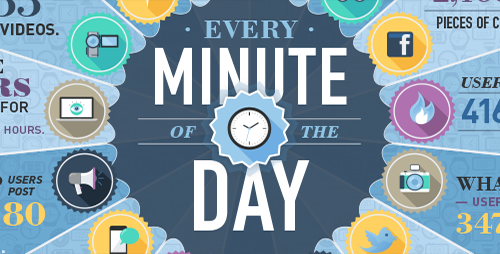
There is a ton of information available today: With over 130 million books and a billion web sites officially registered, there's a lot to read. Add to that enormous library user-generated content, like the over 5 million Wikipedia articles (for just English), or the 300+ hours of video added to YouTube every minute, or the over 4,000,000 blog posts/day, or the incredible amount of information shared and published and consumed every minute...It's obvious that without tools to navigate this sea of information, it is easy to get lost, be misinformed, or to never find what you needed in the first place.

60 seconds of internet: Some numbers

The question, then, is how do we make use of all this information? Is it impossible to make sense of all this "big data"? Can we harness it to harvest useful information?

Wednesday, April 6, 2016

Literacy: Timeless Skill, Contemporary Skillset


Our world is as fluid as an airplane beverage during turbulence. Due to the ever-shifting nature of communication, it is essential to develop methods of sifting through, confirming, and effectively using the massive amount of data available to us. Since all communication-related problems cannot be discussed in such a short video, we have prepared a presentation to introduce our arguments in more detail. Our hope is that this project may be used as your own springboard for thinking about the world around you.


Monday, March 28, 2016

Interesting Video about Communication in the 21st century

This is a video I found for the class that I think pertains to multiple groups, and which I found interesting. Watch at least the first 3 minutes. It's called 10 Ways to have a better conversation (yes, it's a TED talk):
Hopefully it is useful to you. If not, apologies.

Building Literacy in a New Age: Skills and Suggestions

There is an enormous amount of information available today, with a nearly unfathomable additions every day. It is impossible for an individual to sift through this information, causing us to rely on synthesized data from other sources. Taking information in second-hand, however, leads to problems, and to be able to use and understand information (to be literate) in such an environment, we need some tools. For a brief overview of this information, pursue this visual summary:

A quick video introducing everything is also below.


For more details, read on.

Friday, March 25, 2016

A proposed tool for combating internet misinformation, v3

This is the third iteration of a collaborative web platform that would allow the informed on the internet to carefully curate and cross-reference large amounts of data while simultaneously improving access to and clarifying authority of information while making the information easier to understand for people with no background in that topic and limiting or clarifying the biases in presentation and/or consumption of that information. Sounds pretty lofty, right? Well, here's what it looks like.

Read on to have this explained.

Navigating a sea of information, v3

There is a ton of information available today. With over 130 million books and a billion web sites officially registered, there's a lot to read. Add to that huge amount of information the user-generated content like the over 5 million Wikipedia articles (for just English), or the 300+ hours of video added to YouTube every minute, or the over 4,000,000 blog posts/day, or the incredible amount of information shared and published and consumed every minute (see below, or here for a great infographic from 2013), and it's obvious that without tools to navigate this sea of information, it will be easy to get lost, be misinformed, or to never find what you needed in the first place.
60 seconds of internet: Some numbers
You'll want to click that. It shows you then numbers (which are staggering), but it also gives a little update from the CEO of the company that produced it.

I recognize that this is a long post, so I made a 3 minute video summary of it to help orient you. I feel these ideas and topics are vitally important, and so I want to make this as digestible as possible while I'm exploring the topics. When I post my final version, it will be even more digestible, so please bear with me.
The question, then, is how do we make use of all this information? Is it impossible to make sense of all this "big data", or can we harness it to harvest useful information?

Wednesday, March 23, 2016

Caucus or kakas - thoughts on my first Caucus

I'm an American, and in our massively convoluted election system, it's time for preliminary votes for the upcoming presidential election. We have two political parties, the Republican and Democratic, and both parties (as well as the minor parties) usually hold events before the preliminary elections, including Caucuses (which are logistic meetings to choose delegates and discuss how to get more involved in advertising or rallying support). Often, the preliminary votes are cast at caucuses, and that was the case in Utah this year.

I attended the caucuses for both parties last night, and I want to just hit on a few thoughts I had about that experience, and then tie this into other ideas I've been thinking about for this blog.
Huge Crowds at Caucuses

Monday, March 21, 2016

Building New Literacy in a new way: proposed videoscript

We have previously posted the brief summary of our group project on 21st Century Literacy. We actually condensed a larger script down, and felt that we should post the full script below, with some extra visuals. Enjoy! 


Sunday, March 20, 2016

Building New Literacy in a New Age: Proposed Format

In periods of transition, many people naturally try to solve new problems in old ways.

They usually fail.

Literacy, in its traditional sense, is viewed as an important indicator of how well someone can function in society. Likewise, in the Age of Information, new literacy skills need to be developed. 

In our section of a larger class project, not only do we wish to show the need for these skills, but we also want to further develop them in ourselves. Multi-media platforms are an excellent way to spread information.


Consider the above video from YouTube channel SciShow.  

Project Log: J. Argyle

This is me and my older daughter on our first day of school this year:
Here is a summary of my posts and research and such. It seems nobody reads my posts, perhaps because they are a little long, but I will solicit comments on my most recent posts, please:


Rhetorical Techniques for Video Content, part 2

Continuing from part 1, where I mostly covered format, I wanted to hit a couple of neat rhetorical techniques that I have seen in my thousands of hours of YouTube-ing. I will try to lump these in categories, but some channels refuse to be categorized. I will also embed the best examples that I have seen in rhetorical presentation (I'll try to keep it under 5 videos), otherwise look for the pile of links in my comments.
Anyway, the point of this post is to help you to find rhetorical devices and examples of rhetorical form that you can employ in your own argumentative video. This is a long post, so find the section that matters to you now, or check out a few specific examples at the end. This is to be like a resource for you, to be visited several times when you need it.

That said, for our class project, I would strongly recommend that you look at how VSauce3 does his videos in general (discussed below). As far as rhetoric goes, these videos are the best of the best (in my opinion). I would also strongly recommend you watch their video PORTALS, and VSauce2's video on History of Recording Ourselves, because they both very closely relate to our main argument and would give us several ideas for a final video.

Ready?

Wednesday, March 16, 2016

Discussion on the problems of misinformation

So, there was quite a bit of discussion generated on my facebook wall and in multiple discussions about my initial post (as well as my first draft at a possible solution). Since none of these comments made it to the blog, let me transfer the discussion, in bullet-point form, for the sake of facilitating a broader discussion. To see the evolution of the solution draft, see this post.
Creating a Discussion

Monday, March 14, 2016

An updated proposed solution to misinformation

In discussions with classmates, lab colleagues, friends, professors, and others, here are some ideas for improving the solution first proposed here.
Solutions Require Collaboration

Wednesday, March 9, 2016

A possible mis-information solution

In another blog post, I describe problems with trying to access reliable information. Generally, academic journals are considered to have the most reliable information (though they aren't without problems), but there is a huge flaw in the way these journals operate.
The way academia disseminates information currently is, at best, non-ideal for a world of internet access and rapid communication: great discoveries are made, but that information is held back from the world by the slow process of journal publication and then locked behind paywalls and poor circulation when finally published. A quick illustration: a BYU nursing professor did a study on the effects of mixing drugs, particularly in children, and found that it is fairly common to mix drugs that, together, have terrible consequences for the children receiving the treatments. To get tenure at BYU, she published these findings in a scholarly journal, and for those who need the information most (doctors in India and poorer regions) to access it, they must pay $35, which might as well be $35000, because they can't afford that for one article. And so, children continue getting deadly combinations of drugs.


The benefit is that it is peer reviewed, and curated, which many academics are leery of losing if they switch to a more accessible model. This is why we plan to meet academics half-way, creating a system they can buy into now, and gradually transforming it to serve all the same purposes as the more traditional publication routes, but with all the benefits of an open web.

There's too much information available to not understand how to make use of it

There is a ton of information available today. With nearly 130 million books and a billion web sites officially registered, there's a lot to read. Add to that huge amount of information the user-generated content like the over 5 million Wikipedia articles (for just English), or the 300 hours of video added to YouTube every minute, or the over 2,000,000 posts/day in blog land, or the fact that facebook sees over 350 million new pictures uploaded every day, and you can easily see that without tools to navigate this sea of information, it will be easy to get lost, be misinformed, or to never find what you needed in the first place.
The left side of the image above cites statistics used by Markham Nolan in his TED talk given in 2012. The difference between those numbers and the ones I just looked up are...staggering, to say the least, telling us the the deluge of new information is accelerating, not slowing down.

I first want to emphasize that no information is completely worthless; it just depends on what you're using it for. I wish to discuss methods for vetting the truthfulness of information that we find, be it through tweets or facebook posts or books and news outlets. I want to, with your help, reader, create a toolbox that the average person can access and use (with minimal training) to vet just about anything they read/watch, because if it's not fairly easy to use, it won't be used. Read on for some initial discussion on the matter.

Tuesday, March 8, 2016

Rhetorical Techniques for Video Content, part 1

I need to start with a confession: I watch a lot of YouTube. At least 4 hours a week. I have watched over 5000 hours over the last five years. I recently have taken steps to watching less, however: I pared down my subscriptions from over 200 to a mere 131 with the content most interesting to me. Among those are many channels that make persuasive arguments or exemplify amazing collaboration. So, I hand-picked some 50 videos to analyze for our class and in general to give us ideas for creating informational and/or persuasive content. Since that makes a really long blog post, I will cover only a few different categories of videos with lots of examples this time, and will give more later. I, naturally, will save the best for last, so mash that "read more" link below and slowly scroll to the bottom, soaking in the categories as you go.

There are also two specific examples that I feel everybody interested in spreading ideas collaboratively should watch that will be at the bottom, so please go check those out.

As a teaser, here's a satirical look at rhetorical techniques in TED talks:

Wednesday, March 2, 2016

Navigating the sea of information isn't impossible

I did a survey on my facebook wall asking people about three issues that I felt were big issues, and which ones they felt were more important. Unanimously, all respondents thought that the following is one of the most severe problems in the modern world: understanding what information is valuable, and accessing that information. In fact, Mark (a friend of mine) made the comment that the other two problems I listed would be at least partially solved by coming up with a way to reliably navigate the sea of information that is available to us today. Below is my rough brain dump on that topic, fleshing it out a little, and I'd be very interested in your thoughts and input on this idea.
There is a ton of information available today. In the image above, you see just how much information is added to each of those media platforms. The question then becomes: how much of that information is valuable to a certain task (like looking up something, or trying to figure something out), and how far can we trust it?